
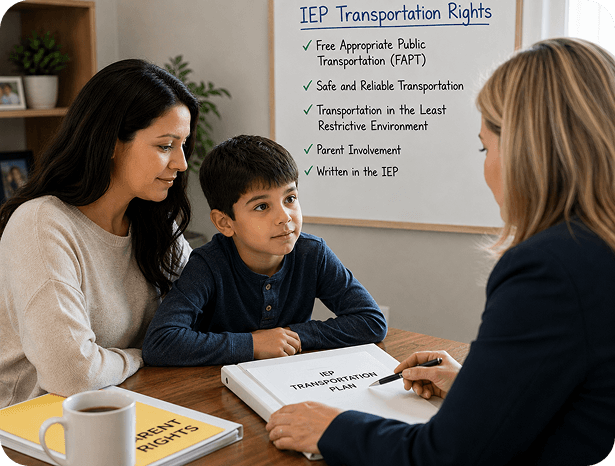
IEP Transportation Rights: What Every Parent Needs to Know

Posted by: By Yunirides
Aug 19, 2026
Many parents view school transportation as a convenience that the district provides. For a child with an IEP, it can be something else entirely: a legal entitlement, backed by federal law, that the district must provide.
If your child's IEP includes transportation, or you think it should, here's what you're entitled to and what to do if IEP transportation is denied by the district.
Transportation Is a Legal Right, Not a Favor
Under the Individuals with Disabilities Education Act (IDEA), transportation is classified as a "related service" support is required to help a student benefit from special education. When transportation is written into a student's IEP, the district is legally obligated to provide it, at no cost to the family. That can mean door-to-door pickup, a wheelchair-accessible vehicle, a shorter ride time, or a trained aide on board, depending on what the IEP specifies.
This is worth repeating because so many parents don't realize it: this isn't a courtesy the district extends. It's a legal requirement and treating it as optional is a compliance failure on the district's part. For a full breakdown of what IEP transportation covers, see our complete parent's guide to IEP transportation.
Who Decides If Your Child Qualifies
Transportation eligibility isn't automatic just because a child has a disability. If your child's IEP doesn't currently include transportation and you believe it should, you can request that it be added or reviewed at any IEP meeting, not just the annual one. To strengthen the request at the meeting, you will have to present documentation from a doctor, therapist, or behavioral specialist explaining why your child needs IEP transportation.
If Transportation on the IEP Is Denied
Sometimes the IEP team declines to add transportation as a related service, even when a parent has requested it. If your child's IEP transportation is denied, you're not without options:
- Ask for the denial in writing with a stated reason. The district is required to explain why transportation on the IEP was denied, not just say no verbally in the meeting.
- Request updated documentation. If the denial was based on insufficient medical or behavioral evidence, ask what specific documentation would change the outcome, and get an updated evaluation if needed.
- You can disagree in writing. Parents have the right to file a written objection to any part of the IEP, including a transportation denial, and that objection becomes part of the record.
- Use the same escalation path as non-compliance. A wrongful denial can be challenged through your state's IDEA complaint process, mediation, or due process, the same avenues available when a district fails to deliver transportation it already agreed to.
A denial isn't necessarily final. It's the starting point for a documented response, not a dead end.
What the District Is Actually Required to Provide
Once transportation is written into the IEP, the district must provide the services specified, which may include:
- Door-to-door pickup, not just a curb stop
- A wheelchair-accessible or otherwise adapted vehicle
- A trained aide or monitor riding along
- A capped ride time
- Coordination with therapy or medical appointments tied to the school day
What to Do When a District Isn't Complying
If transportation in the IEP isn't being provided as written, or was denied without adequate explanation, you have options:
- Put it in writing. Document the specific gap (a missed pickup, a wrong vehicle, an aide who wasn't present) with dates. Email creates a paper trail that a phone call doesn't.
- Request an IEP team meeting. You don't have to wait for the annual review. Persistent non-compliance is grounds to reconvene the team.
- Contact your state's special education office. Every state has a formal complaint process for IDEA violations, separate from the district itself.
- Consider mediation or due process. For unresolved disputes, IDEA provides for mediation and, if needed, a formal due process hearing.
When IEP Transportation Overlaps With Other Protections
A student experiencing homelessness who also has a disability can be covered under both an IEP and the McKinney-Vento Act simultaneously, and the district is responsible for coordinating both sets of obligations rather than treating them as competing claims. If this might apply to your family, our guide to McKinney-Vento transportation rights breaks down what schools are required to provide.
What to Ask Before Choosing a Transportation Provider
If your district contracts out special needs transportation rather than running it in-house, the same rights still apply. Before you sign off on a provider, or push your district to change one, it's worth asking about driver training on securement systems and behavioral support, real-time tracking, and how incidents get reported. We cover the full list in 12 questions every parent should ask before signing a transportation contract.
The Bottom Line
Transportation tied to your child's IEP isn't a favor. It's a legal right, and understanding exactly what it covers is the first step to making sure your child actually receives it. If your district isn't delivering what's written in the plan, you have real, documented paths to fix that — starting with putting the gap in writing.
If you're setting up IEP transportation for the first time, or you're not confident your current provider can actually deliver on what's required, book a consultation with Yuni Rides to talk through your child's specific needs.
Frequently Asked Questions
- Is IEP transportation free for families? Yes. If transportation is written into your child's IEP as a related service, the district must provide it at no cost.
- Can I request transportation be added to my child's IEP? Yes. You can request that transportation be added or reviewed at any IEP meeting, not just the annual review. Supporting documentation from a doctor or therapist can strengthen the request.
- What can I do if the district isn't following the transportation plan in my child's IEP? Document the specific gap in writing, request an IEP team meeting, and if it continues, file a formal complaint with your state's special education office. Mediation and due process are also available under IDEA for unresolved disputes.
- Can a student qualify for both IEP transportation and McKinney-Vento protections? Yes. A student experiencing homelessness who also has a disability can be covered under both at the same time, and the district is responsible for coordinating both.
- Does IEP transportation cover more than the ride to school? It can. Depending on what's written in the IEP, this may include coordination with therapy or medical appointments tied to the school day, not just the standard commute.
- What can I do if my child's IEP transportation is denied? Ask for the denial in writing with a specific reason, request guidance on what documentation would change the decision, and file a written objection if you disagree. If the denial seems unjustified, the same complaint, mediation, and due process options used for non-compliance apply here too.
Apply to Drive With Yuni Rides
Looking for a driving opportunity with predictable weekday schedules and consistent route assignments? Join Yuni Rides today and help make a difference in your community.