
The Ultimate Guide to Special Needs Student Transportation (2026)

Posted by: By Yunirides
Jun 30, 2026
What is special needs student transportation?
Special needs student transportation refers to individualized, legally mandated transportation services for students with disabilities or housing instability. Under IDEA, students with IEPs are entitled to free transportation when needed. Under McKinney-Vento, homeless students receive free transport to their school of origin. These services use specialized vehicles, trained drivers, and individualized accommodations — distinct from regular school bus service.
This comprehensive guide covers every aspect of special needs student transportation — from federal law requirements to practical tips for parents and school administrators. Whether you are a parent navigating your child's first IEP, a district transportation director evaluating providers, or a school counselor helping a family in crisis, this guide gives you everything you need.
Part 1: The Legal Framework
IDEA and IEP Transportation
The Individuals with Disabilities Education Act (IDEA) is the federal law that guarantees free appropriate public education (FAPE) for students with disabilities ages 3–21. Under IDEA (34 CFR 300.34), transportation is explicitly listed as a 'related service' — meaning it must be provided at no cost when it is necessary for the student to access their education.
Key IDEA transportation provisions: districts must provide transportation when the IEP team determines it is necessary; transportation must be provided to the school where the student is placed; the district bears all costs; transportation services must be described specifically in the IEP document.
Section 504 and Transportation
Students with 504 plans (disability accommodations that do not require special education) may also qualify for transportation accommodations. While 504 does not mandate the same level of individualized transportation as IEP, districts must provide equal access to transportation and reasonable accommodations.
McKinney-Vento and Housing-Insecure Students
The McKinney-Vento Homeless Assistance Act requires free transportation for students experiencing homelessness to their school of origin. This applies regardless of whether the student has an IEP — it is a separate protection for housing instability.
Part 2: Types of Special Needs Transportation Services
Door-to-Door Service
Door-to-door transportation picks the student up at their home address and drops them off at the school entrance (or specific designated location). This is the most common IEP transportation arrangement for students who cannot safely wait at a bus stop or navigate independently.
Curb-to-Curb Service
Similar to door-to-door but picks up at the curb of the home address rather than the door. Appropriate for students who can walk to the curb but cannot walk to a standard bus stop.
Wheelchair-Accessible Transportation
Vehicles equipped with certified wheelchair lifts or ramps, proper tie-down systems, and trained staff to assist students using wheelchairs, scooters, or other mobility devices.
Aide-Accompanied Transportation
A trained aide rides with the student when the IEP specifies one-on-one support during transport. Aides may assist with behavioral management, medical monitoring, or physical assistance.
Medical Transportation
For students with medically fragile conditions, transportation may require a driver trained in specific medical protocols and a vehicle equipped with emergency equipment.
Part 3: The IEP Transportation Planning Process
Transportation should be discussed at every IEP meeting if it is a current or potential need. The IEP transportation section should specify:
- Whether transportation is a related service (Yes/No)
- Type of transportation and vehicle requirements
- Pickup and drop-off location (exact address)
- Pickup window (e.g., 7:05–7:15 AM)
- Whether an aide is required
- Behavioral supports or protocols for the driver
- Communication method between driver and family
- What to do in case of emergency or behavioral incident
Part 4: Common Problems and How to Solve Them
Chronic Lateness
Document every late pickup with date, time, and how late. After three incidents, send a written complaint to the special education director. If lateness continues, file a state complaint — chronic failures to implement IEP transportation are procedural violations.
Driver Changes Without Notice
Students with autism in particular can be severely disrupted by unexpected driver changes. The IEP should specify the notification requirement (e.g., 24-hour advance notice of driver substitutions with photo identification).
Behavioral Incidents on the Vehicle
Any behavioral incident during transport should be documented in writing and shared with parents the same day. The district may need to review the transportation plan and add de-escalation supports if incidents are recurring.
District Refuses to Provide Transportation
If an IEP team denies transportation, the district must issue Prior Written Notice (PWN) explaining the refusal. Parents can then file a state complaint or request due process. Under IDEA's pendency provision, previously provided services continue during disputes.
Part 5: Vehicle and Driver Standards
Quality special needs transportation providers maintain standards that exceed general commercial transportation:
- Multi-state fingerprint background checks renewed annually
- Special education-specific driver training (not just CDL)
- CPR/First Aid certification for all drivers
- De-escalation and crisis intervention training
- Vehicle inspections exceeding state minimum requirements
- Child safety restraint systems certified by CPS technicians
- Real-time GPS and parent communication systems
Part 6: What to Ask When Evaluating a Provider
When a school district or family is selecting a special needs transportation provider, these are the non-negotiable questions:
- What specific special education training do all drivers complete?
- How often are background checks renewed?
- What is your on-time delivery rate with existing school district clients?
- Can you provide references from current district contracts?
- How are parents notified of delays, substitutions, or incidents?
- Can your vehicles accommodate the specific disability needs in our student's IEP?
Part 7: How Yuni Rides Serves Special Needs Students Across 5 States
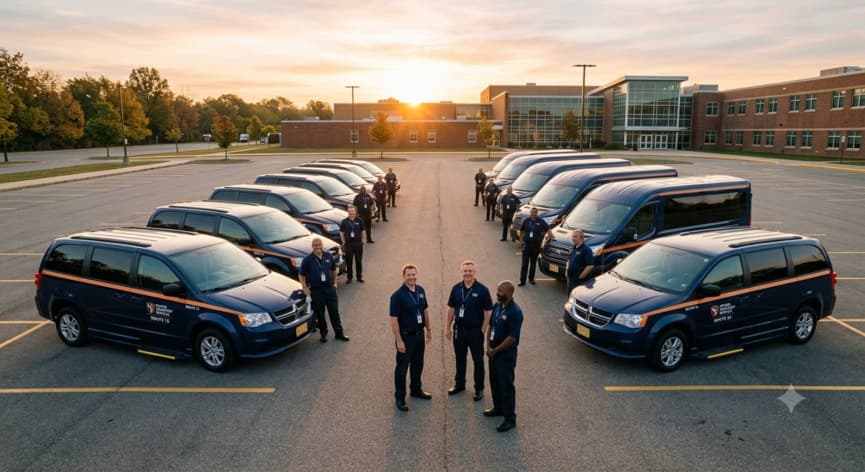
Yuni Rides is a specialized student transportation provider operating exclusively in the IEP, special needs, and McKinney-Vento space. We are not a rideshare app. We are not a general taxi service. We exist specifically to transport vulnerable students safely, and we do this across Washington, California, Texas, Arizona, and Illinois.
Our approach: every student receives a dedicated driver assignment, a communication plan for their family, and a transportation profile that the driver reviews before their first route. We coordinate directly with school special education departments and McKinney-Vento liaisons, not just families.
Yuni Rides: The Specialized Transportation Team Built for Students Like Yours
Whether you need to scale up your district's logistics solution or establish personal routing clarity for an IEP program, our team offers unmatched, legally compliant support. Reach out to Yuni Rides today at 415-535-2155 or connect with us at info@yunirides.com.
Apply to Drive With Yuni Rides
Looking for a driving opportunity with predictable weekday schedules and consistent route assignments? Join Yuni Rides today and help make a difference in your community.