
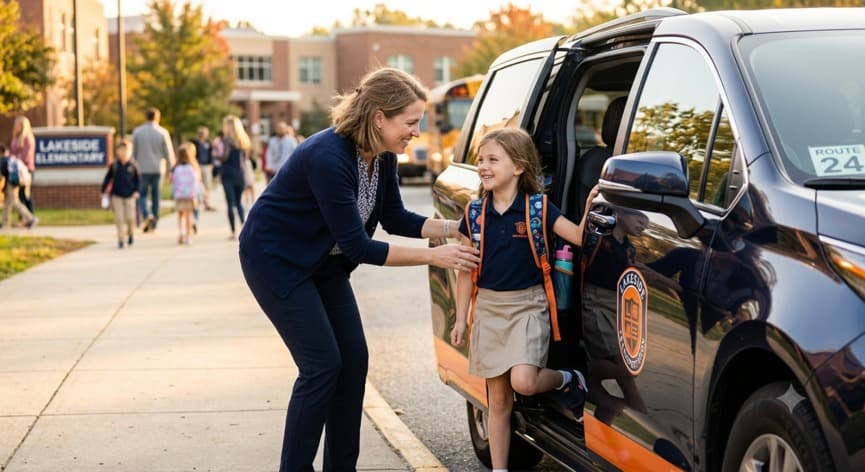
What Is IEP Transportation? A Complete Parent's Guide (2026)

Posted by: By Yunirides
Jun 30, 2026
What is IEP transportation?
IEP transportation is a free, legally mandated related service under the Individuals with Disabilities Education Act (IDEA) that school districts must provide to students with disabilities when transportation is listed in their Individualized Education Program (IEP). It covers specialized vehicles, trained aides, door-to-door service, and any accommodations needed for the student to access their education safely.
If your child has an Individualized Education Program (IEP), they may be entitled to free specialized transportation to and from school — and most parents never know they can request it. Under federal law, transportation is classified as a 'related service,' meaning it must be provided at no cost to your family when it is necessary for your child to receive their education.
This guide explains everything you need to know about IEP transportation: what it covers, how to request it, what the school district is required to provide, and what to do when the system fails your child.
What Does IEP Transportation Cover?
IEP transportation is far more than a bus ride. Under IDEA (34 CFR 300.34), transportation as a related service includes:
- Travel to and from school (home to school and school to home)
- Travel between schools (for students attending multiple programs)
- Specialized equipment: wheelchair lifts, harnesses, safety vests, car seats
- An aide or paraprofessional on the vehicle when required by the IEP
- Door-to-door service when the student cannot safely wait at a bus stop
- Extended school year (ESY) transportation during summer programs
- Transportation to private schools, if the IEP places the student there
The critical point: transportation must be listed as a related service in the IEP document for the district to be legally obligated to provide it. If it is not written in, the district is not required to arrange it — even if your child clearly needs it.
Who Qualifies for IEP Transportation?
Does every student with an IEP get free transportation?
Not automatically. A student with an IEP qualifies for free transportation only when the IEP team determines that transportation is necessary for the student to access their education. The team — which includes parents — makes this determination case by case. Parents can and should request transportation be added to the IEP if their child needs it.
Any student between ages 3 and 21 who qualifies for special education under one of IDEA's 13 disability categories may be eligible for IEP transportation. Qualifying disabilities include:
- Autism Spectrum Disorder (ASD)
- Intellectual disabilities
- Specific learning disabilities
- Emotional disturbance or behavioral challenges
- Physical disabilities or orthopedic impairments
- Traumatic brain injury (TBI)
- Speech or language impairments
- Visual or hearing impairments
Eligibility is not based solely on diagnosis. The IEP team evaluates whether the disability makes it impossible or unsafe for the student to use regular transportation. A student with autism who cannot wait at a bus stop independently, for instance, may qualify even if they do not have a physical disability.
How to Request IEP Transportation for Your Child
If transportation is not already listed in your child's IEP, you can request it at any time. Here is the step-by-step process:
- Step 1: Submit a written request to the special education coordinator at your child's school. Written requests create a paper trail and trigger timelines.
- Step 2: Request an IEP meeting specifically to discuss transportation. You have the right to call an IEP meeting at any time.
- Step 3: At the meeting, present documentation of why your child needs specialized transportation — medical evaluations, therapist letters, or behavioral incident reports.
- Step 4: Negotiate specific transportation services in the IEP document — vehicle type, aide requirements, pickup window, route details.
- Step 5: If denied, request the district's written explanation (Prior Written Notice) and consider filing a complaint with your state department of education.
What Must the IEP Say About Transportation?
A well-written IEP transportation section should specify:
- Whether transportation is a related service (yes or no)
- Type of vehicle (standard bus, minivan, wheelchair-accessible van)
- Whether an aide is required and what their role is
- Pickup and drop-off location (home address, specific door)
- Pickup window (e.g., 7:00–7:15 AM)
- Behavioral or medical protocols the driver must follow
- Communication method between driver and parent (app, text, phone)
Vague transportation language like 'student will receive transportation' is insufficient. Advocate for specific, measurable terms so there is no ambiguity about what the district must provide.
What Is the Difference Between IEP Transportation and a Regular School Bus?
How is IEP transportation different from a regular school bus?
IEP transportation is legally mandated, individualized, and free. It uses smaller vehicles with specialized equipment, trained drivers, and sometimes a dedicated aide. Regular school buses are not required to have specialized equipment, door-to-door service, or aides. IEP transportation is tailored to the student's disability-related needs.
Regular school buses operate fixed routes with standard stop locations. IEP transportation, by contrast, is individualized. The route, vehicle, pickup time, and staff qualifications are all determined by the student's IEP.
What Happens If the School District Refuses?
Districts cannot legally deny IEP transportation if the student's disability requires it. If you face a refusal:
- Request Prior Written Notice (PWN) — the district must document their refusal and reasoning in writing
- File a State Complaint with your state education agency (response required within 60 days)
- Request a Due Process Hearing for formal dispute resolution
- Contact your Parent Training and Information (PTI) Center for free advocacy support
- Involve a special education attorney if the district continues to deny legally required services
Under IDEA's 'pendency' (stay-put) provision, your child is entitled to continue receiving transportation services that were previously in their IEP while any dispute is being resolved.
How Yuni Rides Supports IEP Students Across 5 States
Yuni Rides specializes exclusively in transportation for students with IEPs, special needs, and McKinney-Vento status. Unlike rideshare apps or general transportation services, every Yuni Rides driver is trained in special education protocols and student safety. We serve school districts and families across Washington, California, Texas, Arizona, and Illinois.
Services we provide for IEP students include: door-to-door pickup and drop-off, wheelchair-accessible vehicles, trained aides upon request, real-time GPS tracking, direct parent communication, and full compliance with district IEP specifications.
Frequently Asked Questions About IEP Transportation
- Can parents choose the transportation provider for their IEP child? A: In most cases, the school district selects the transportation provider. However, parents can advocate during the IEP meeting for specific requirements — vehicle type, driver training, aide presence — and districts must meet those requirements. Some districts allow parent-preferred providers when the district cannot meet IEP specifications internally.
- Does IEP transportation apply during summer school? A: Yes. If a student's IEP includes Extended School Year (ESY) services, transportation to ESY must also be provided at no cost if transportation is listed as a related service in the IEP.
- Can a student be removed from IEP transportation as a disciplinary measure? A: No. Under IDEA, transportation is a related service, not a privilege. Disciplinary removal from transportation must follow IDEA's specific disciplinary procedures and cannot simply replace education-related services.
- What if my child's IEP transportation is consistently late? A: Chronic lateness may constitute a failure to implement the IEP, which is a procedural violation. Document every late pickup, contact the district transportation coordinator in writing, and if the pattern continues, file a state complaint.
- Does IEP transportation cover students placed in private schools? A: Yes, if the district has placed the student in a private school to meet their IEP needs, the district must also provide transportation to that placement. If parents choose a private school independently, the district's obligation is more limited but transportation services may still apply.
Need IEP Transportation in WA, CA, TX, AZ, or IL? Yuni Rides Can Help.
Yuni Rides partners with FirstAlt and participating districts throughout California and Illinois to provide trained drivers, consistent assignments, and real-time communication for families who need more than a bus stop. If you're evaluating options in your area, we'd welcome the conversation. Call 415-535-2155 or email info@yunirides.com to get started.
Apply to Drive With Yuni Rides
Looking for a driving opportunity with predictable weekday schedules and consistent route assignments? Join Yuni Rides today and help make a difference in your community.